


Sunday, April 09, 2006
When animals first conquered the land
There has been much made this week of the discovery of the so called ‘fishapod’ Tiktaalik roseae – a fossil with some features intermediate between us land vertebrates and our piscine relatives. And so there should be, Tiktaalik gives us a real clue as to what our ancestors must have looked like 375 million years ago.1 When we talk about the origin of the tetrapod limb we are talking about the origin of our limb, the bones in Tiktaalik’s fins are related to the ones in your arm and your wrist. The transition that the animals made from our ancestral home the ocean to the land is truly one of greatest events in life on earth. However, contra to articles published this week by the New York Times, Time Magazine and the San Francisco Chronicle us vertebrates were beaten to this ‘landmark’ by at least 50 million years.
The arthropods (which are distinguished by their segmented bodies and include insects spiders and crustaceans) are, by any measure, the most successful group of animals on the face of the earth. 80% of described animal species are arthropods and they have conquered every environment on earth. Shrimp and crabs live in deep sea vents and springtails (Collembla) are the largest permanent fixtures of the Antarctic fauna. The first example from the fossil record of an arthropod clearly adapted for life on land comes in the form of a Pneumodesmus newmani a 428 million year old millipede. Pneumodesmus (which means air breathing) sports tiny structures called spiracles which are the basis of respiration in modern insects but would become flooded and useless underwater.
The Pneumodesmus fossil already puts arthropods on land 52 million years before vertebrates but given the extreme improbability of a given species being fossilised and that fossil then being discovered it seems likely there where myriapods (centipedes, millipedes and their allies) on land even before this date. To have a look at just how far back the arthropod’s colonisation of land might go a team of American researchers constructed a phylogeny of the arthropods and used molecular clock calculations estimate the times of divergence. They reason since there is no fossil record of centipedes or millipedes that live in water it is likely that these two groups share a common ancestor that lived on land. This would mean dating the split between these groups (or calculating when that ancestor lived) would set the latest possible time for the emergence of terrestrial animals. Here is their tree with molecular clock estimates for the splits:
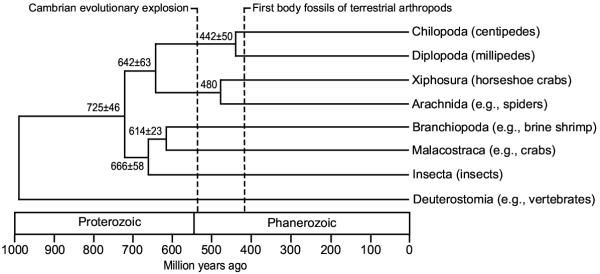
So, the common ancestors of today’s centipedes and millipedes is estimated to have lived 442 million years ago (plus or minus a significant margin of error.) Remembering that we inferred from the fossil record that this ancestor was fully terrestrial we can now estimate animals lived on land something like 65 million years before proto-limbs supported Tiktaalik’s weight on Devonian tera firma. Arthropods beat us to land by the same length of time that dinosaurs have been extinct!
The other fascinating thing revealed in the phylogram above is the amount of times that the arthropods have conquered the land. Most of the groups within the arthropods parted ways well before their emergence on land, in the edited tree presented below the red marks represent individual lineages that have made it to land.
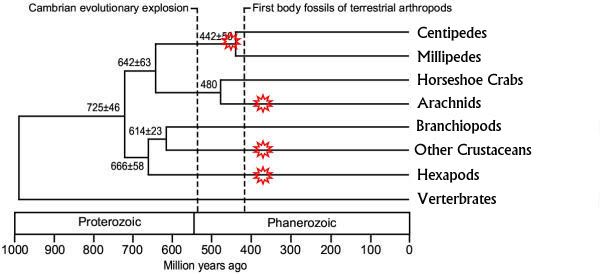
Hexapods (including insects and springtails), crustaceans (in the form of amphipods and wood lice) and arachnids (spiders and mites) must have all had some pioneer organism that independently make that group’s first steps on land. And that’s just the arthropods. Molluscs, annelids, nematodes and tardigrades all have representatives that have left their ancestral home to make a living on dry land. In the case of the hexapods at least it is likely that event also predates the emergence of terrestrial vertebrates. A fossil springtail estimated to be 400 million years old has been found in Scotland and cladistic analyses suggest the springtails can trace their origin to a terrestrial ancestor.
So by all means let’s celebrate the discovery of Tiktaalik but let’s remember when we imagine the first small steps for vertebrates on land we aren’t imagining a giant leap for animal kind so much as one tardy lineage finally joining the party.
18 Comments:

thanks so much
this helped a bunch with a bio project

Muebles
cheap phentermine 37.5 without prescription
Signature:
The place to play all unblocked games online. Here you can find every blocked games such as: unblockedgames , unblocked games happy , unblocked games 77 , gmod
Signature:
The place to play all
العاب
العاب طبخ
العاب بنات
cara menghilangkan kista bartholin
cara mengobati infeksi ginjal
pengobatan paru-paru basah secara alami
obat tipes tradisional untuk anak dan dewasa
obat infeksi saluran pernafasan akut
cara menyembuhkan kurap di kepala secara alami
Regard Telkom University